
For those who are interested in the process of integrating AI into business - using a simple example.
When AI starts working not with the Internet, but with your documents.
A little bit about what's going on "under the hood" to understand how AI finds the necessary information in the company's internal documents and turns it into a systematic response, rather than just searching for information on the Internet.
Imagine an enterprise with thousands of instructions, regulations, and technical documents.
The employee needs to know: «What needs to be checked before launching this equipment?»
Now he has to search for the right document, open it, browse dozens of pages, compare information from different documents and organize it himself in order to get an answer.
If there are thousands of documents, it can take hours to find the information you need. And a mistake or a missed point can be expensive.
Now imagine that an employee just asks this question in a corporate chat.
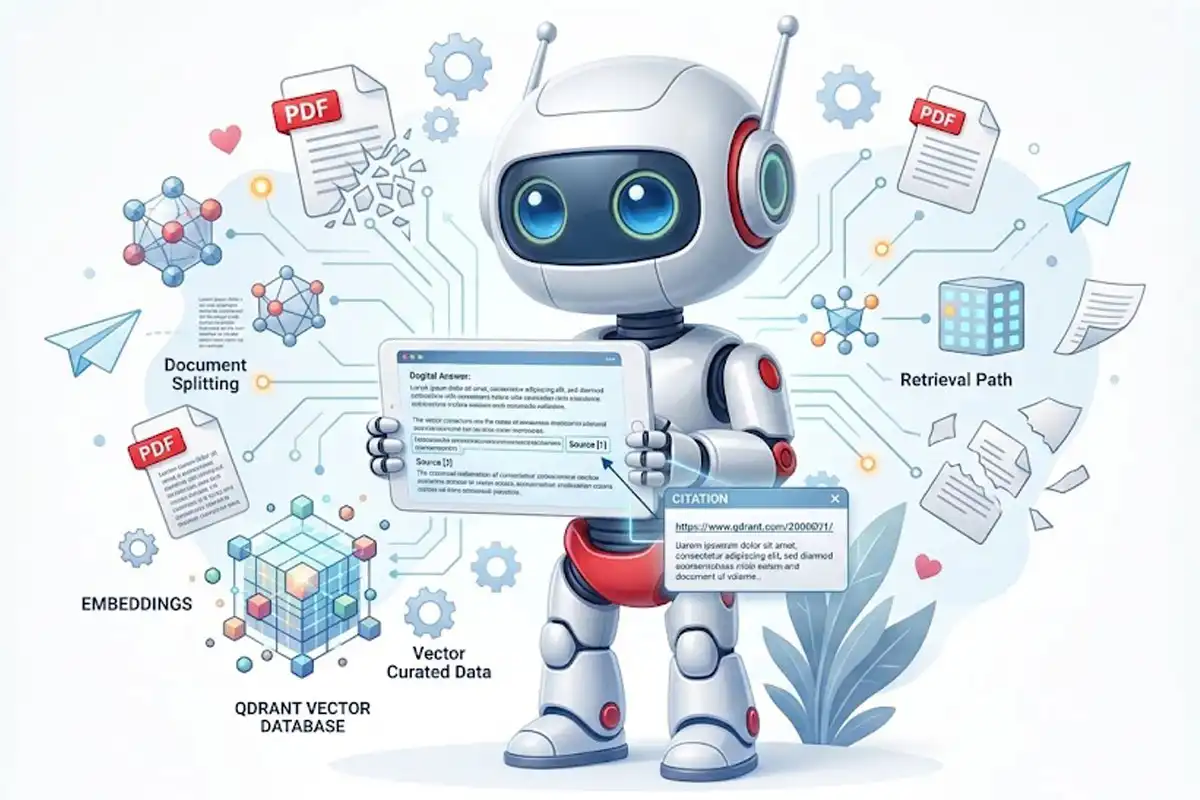
The system finds the necessary documents and specific fragments by itself, after which the AI generates a response and shows on the basis of which documents it was received.
An important point: The AI does not know the contents of the company's internal documents in advance. With each request, it first receives relevant fragments of documents in digital form from the corporate knowledge base, and only then uses this information to form a response.
RAG is used here (a system that allows AI to search for information in company documents).
Documents are split into fragments, and embeddings are created for them (converting text into a digital representation of its meaning). Embeddings and information about the corresponding fragments are then saved, for example, in Qdrant (a database for storing and searching such representations).
For general purposes, the process looks like this:
↓
documents are divided into fragments
↓
embeddings are created for fragments
↓
embeddings and fragment information are saved in Qdrant
And when an employee asks a question:
↓
the question is converted to embedding
↓
the system searches in Qdrant for the closest fragments of documents
↓
the found fragments are transmitted to LLM
↓
LLM analyzes the question and the found information and generates a systematic answer with a link to the source document
At the same time, this entire AI part does not exist separately from the main program. It integrates into the same software stack that the system already runs on: for example, Laravel + Vue, Python + Django, Java + Spring, etc. In other words, you do not need to create a separate program for working with AI. The necessary components are connected to the existing system and work inside its business processes.
And here the main advantage is clearly visible.
Previously, people searched for information in documents and turned it into an answer themselves. Now the system finds the right place in thousands of documents by itself and turns the information found into an understandable answer.
At the same time, a person is not excluded from the process. He simply stops wasting time on mechanical search and processing of information. He gets quick access to corporate knowledge that used to be scattered across a huge array of documents.
That is, AI is not just a GPT chat, as many people perceive it today. It is a tool that can be embedded directly into a business process and made to work with real data, documents, and company tasks.